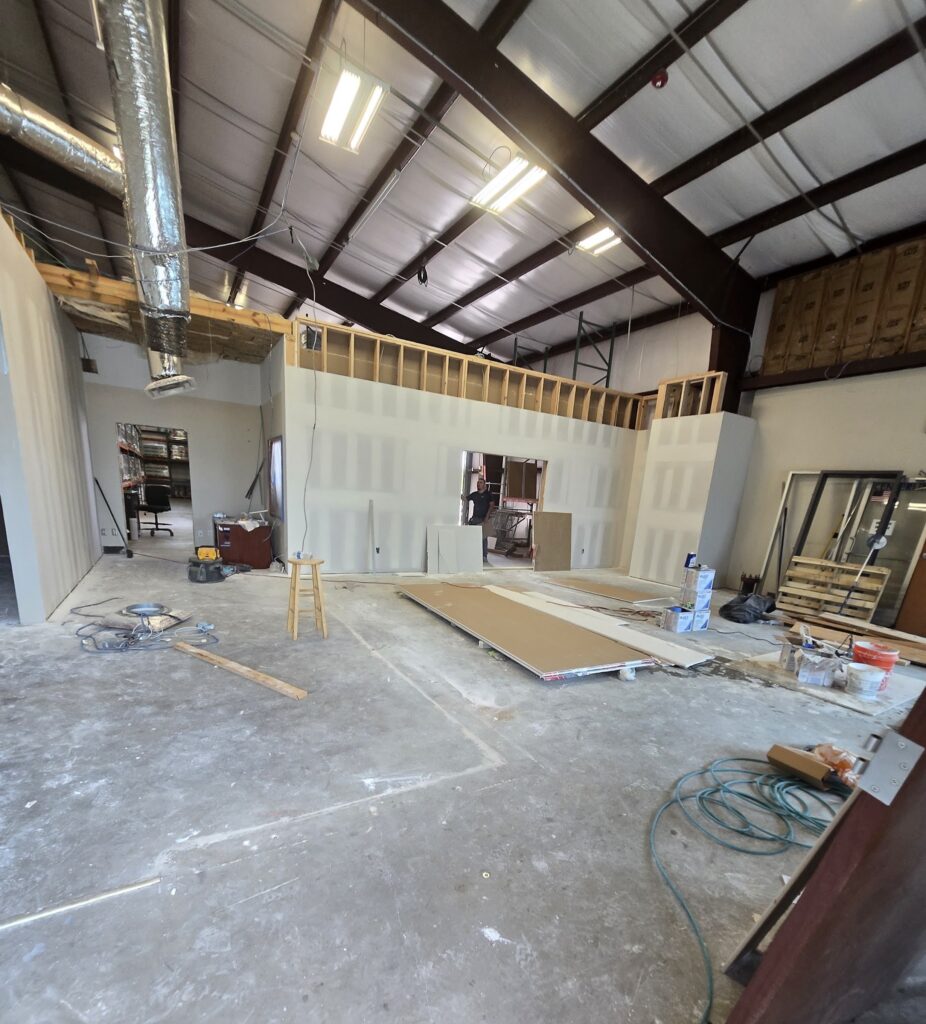
Commercial Remodeling
A dated exterior costs you tenants and customers long before it costs you a repair bill.
The short answer: Exterior commercial remodeling updates the facade, storefront, entries, canopies, signage and site approach of an existing building. In Central Texas most of that work needs a city permit, projects of $50,000 or more must be registered with the state for accessibility review, and historic districts add a design approval before work starts.
This guide walks owners, developers, property managers and facility managers through what an exterior remodel includes, the permits and reviews that apply in New Braunfels, San Antonio and the Hill Country, and how to plan the work around open businesses. It is general information, not legal or tax advice.
In this guide
- What counts as an exterior commercial remodel
- Permits in New Braunfels and San Antonio
- Accessibility: TDLR registration and the path of travel rule
- Historic districts and design review
- Asbestos, energy code and signs
- How to plan an exterior remodel, step by step
- Keeping tenants open during the work
- Incentives worth asking about
- Frequently asked questions
What counts as an exterior commercial remodel
An exterior commercial remodel changes how an existing building looks, performs and welcomes people without changing what the building is. It sits between routine maintenance and full redevelopment.
Facade and cladding
New stucco, stone, brick, metal panel or fiber cement over the existing structure, plus the weather barrier, flashing and sealants behind it.
Storefront and glazing
Aluminum storefront systems, entry doors, windows and hardware. This is where energy performance, security and accessibility meet.
Entries and canopies
Covered entries, canopies, awnings, parapets and towers that give a tired center a new profile and give tenants a place for signage.
Site approach
Parking, striping, curb ramps, sidewalks, lighting and landscaping. Often the part of the project that accessibility rules reach first.
Roof edges and parapets usually get pulled into the scope because the facade ties into them. If the roof is also near the end of its life, compare systems before the facade is detailed. Our guide to commercial roofing systems in Central Texas covers the options, and our commercial roofing team can assess what is there now.
Exterior work is often paired with interior tenant improvements. If you are doing both, read how the commercial build-out process works so the two scopes share one permit strategy and one schedule.
Permits in New Braunfels and San Antonio
Cities issue permits and enforce the building codes they adopt, so the rules change at the city limit line.
New Braunfels
The City of New Braunfels requires a permit any time an owner or contractor intends to construct, enlarge, alter, repair, demolish, move or change the occupancy of a building. Purely cosmetic work, such as painting and floor coverings, is exempt. Commercial permit types in the city’s Online Permit Portal include Alteration/Remodel, Roofing, Sign and Demolition.
New Braunfels enforces the 2021 International Codes and the 2020 National Electrical Code. Its commercial permit checklist asks for three items that catch remodel applicants off guard: an asbestos letter when a building is remodeled or demolished, proof of state accessibility registration for projects over $50,000, and an energy compliance report under the 2021 energy code.
San Antonio
In San Antonio, the Development Services Department (DSD) requires all commercial applications to be submitted online through the BuildSA permitting portal. The city adopted the 2024 International Codes effective May 1, 2025, but kept the 2021 International Energy Conservation Code for energy compliance. DSD also requires an asbestos survey certification with applications for additions, remodels and repairs to existing buildings.
DSD also publishes target review timeframes for complete submittals, shown below. They are targets, not guarantees, and every resubmittal adds time.
| New Braunfels | San Antonio | |
|---|---|---|
| Where to apply | Online Permit Portal, with electronic plan review | BuildSA permitting portal (Development Services) |
| Codes in force | 2021 International Codes, 2020 NEC, 2021 energy code | 2024 International Codes, 2021 energy code |
| Asbestos paperwork | Asbestos letter when a building is remodeled or demolished | Asbestos survey certification with the application |
| Historic approval | Certificate of Alteration (Historic Landmark Commission or Historic Preservation Officer) | Certificate of Appropriateness (Office of Historic Preservation) |
| Published review targets | None published | 3 business days for completeness, then 8 business days (minor plans) or 18 calendar days (complex plans) for initial review |
Outside city limits, the county fire marshal’s office is usually the permitting authority for commercial buildings in Comal, Guadalupe and Bexar counties. Call before assuming no permit is needed.
Accessibility: TDLR registration and the path of travel rule
Accessibility is the rule most likely to expand an exterior remodel, and it is a state program, not a city one.
TDLR registration and review
Under the Texas Architectural Barriers program, run by the Texas Department of Licensing and Regulation (TDLR), the owner must register any building or facility being constructed, renovated or modified with an estimated construction cost of $50,000 or more. TDLR’s current rules set out the sequence:
- Register the project with TDLR. A late fee applies if it is registered after construction is complete.
- Plan review. The design professional submits the plans and specifications to a Registered Accessibility Specialist (RAS) no later than the 20th day after they are issued, not counting weekends and holidays.
- Inspection. The owner must obtain an inspection by a RAS within one year after construction is completed.
- Corrections. If problems are found, the owner responds within 30 days of the report and completes corrections within 270 days.
Projects under $50,000 do not have to register, but TDLR is clear that they still have to comply with the Texas Accessibility Standards (TAS).
The path of travel rule
The 2012 TAS contains a rule that matters on almost every facade and storefront job. When an alteration affects an area that contains a primary function of the building, the path of travel to that area must be made accessible to the maximum extent feasible. That path includes the parking, the route in, and the restrooms, telephones and drinking fountains serving the area.
There is a cost limit. Path of travel upgrades are considered disproportionate when they cost more than 20 percent of the alteration to the primary function area. You still spend up to that limit, in a set priority order: an accessible entrance first, then an accessible route to the altered area, then accessible restrooms, followed by telephones, drinking fountains and finally items such as parking.
Two details help owners. Path of travel elements that already met the 1994 TAS do not have to be upgraded solely because of the alteration, and alterations made only by a tenant do not trigger the landlord’s path of travel duty in areas the landlord controls. A Registered Accessibility Specialist can tell you how the rule applies before the budget is set.
Historic districts and design review
Design review comes before construction, so check the overlay on day one.
New Braunfels
New Braunfels has four local historic districts (Downtown, Mill Street, Sophienburg Hill and Stock) plus individually designated landmarks. A Certificate of Alteration is required before any work that affects the exterior of a landmark or a property in a district. Covered work includes exterior repairs, even in-kind maintenance such as painting or roof replacement, along with alterations, additions, signage and demolition. Approval comes from the Historic Landmark Commission or the Historic Preservation Officer, and minor alterations can be reviewed administratively.
San Antonio
San Antonio requires a Certificate of Appropriateness from the Office of Historic Preservation before starting work on properties in historic districts and River Improvement Overlay districts, on individually designated landmarks and on public properties. It covers exterior modifications and repairs on commercial and residential properties alike. A zoning designation ending in H, HS, HE or HL signals historic status.
Simple requests are approved administratively. Others go to a public hearing before the Historic and Design Review Commission. Starting work first carries a $500 post-work application fee and the risk of a stop work order.
Asbestos, energy code and signs
Asbestos surveys
Texas rules require an asbestos survey before renovation or demolition in public and commercial buildings. A city cannot issue a renovation or demolition permit unless the applicant provides evidence of a survey by a licensed person, or a Texas architect or engineer certifies that the affected parts of the building contain no asbestos. Both cities ask for that paperwork at submittal.
The state definitions focus on a building’s interior space, while federal rules can reach exterior materials, so have a licensed asbestos consultant confirm what applies to a facade-only scope. Demolition also requires notice to the Texas Department of State Health Services at least 10 working days ahead, even when no asbestos is present.
Energy code
Both cities enforce the 2021 International Energy Conservation Code, and how much of it applies depends on how deep the work goes. San Antonio’s guidance, for example, requires an energy report for any remodel where cavities are exposed. Have your architect make that call before storefront and cladding products are selected.
Signs
In New Braunfels, all new signs require a permit and sign contractors must be licensed with the city. Changing the face or wording on an existing sign does not need a permit. Signs attached to the building go through a building permit, and banners need a temporary sign permit. Plan signage with the facade design, not after it.
How to plan an exterior remodel, step by step
- Document what is there. Walk the building with your contractor. Photograph every elevation, note leaks, cracks and failed sealants, and plan a few test openings. Hidden conditions behind old cladding are the biggest budget risk.
- Check the overlays. Look up the zoning, historic status and any overlay district before design starts.
- Set scope and budget together. Bring a general contractor in while the design is still loose, so options are priced before they are drawn.
- Run the accessibility review early. If the cost will reach $50,000, have a Registered Accessibility Specialist identify path of travel work so it is in the budget from the start.
- Order the asbestos survey. Both cities want the paperwork at permit submittal, and results can change the demolition plan.
- Submit for permit. File a complete package: drawings, energy documents where required, the asbestos paperwork and the TDLR registration.
- Close it out. Pass the city’s final inspections, schedule the accessibility inspection within the year TDLR allows, and collect warranties.
Both cities register contractors before permits are issued. Our guide to verifying a general contractor in Texas explains what to check before you sign.
Keeping tenants open during the work
Most exterior remodels happen while the businesses inside are open. The logistics plan matters as much as the design.
Phase by elevation
Work one face or group of suites at a time so no tenant loses its entrance, parking and signage at once.
Protect the public
Covered walkways, barricades and clear detours keep customers away from overhead work.
Keep tenants visible
Temporary signage and banners replace sign bands that are down.
Schedule the loud work
Demolition, saw cutting and deliveries go early or after hours where leases and local rules allow.
Many of the same logistics apply to housing. See our guide to renovating occupied multifamily communities.
Planning an exterior remodel in Central Texas?
Long View Construction Services works with owners, developers and property managers in New Braunfels, San Antonio and the Hill Country. Send us your plans or a few photos of the building, or call (866) 381-6186.
Incentives worth asking about
New Braunfels downtown grant. The city’s Downtown Business Improvement and Preservation Grant Program reimburses up to 25 percent of an approved project’s cost, depending on the funds available, and facade and exterior improvements are one of its categories. The property has to sit inside the downtown reinvestment zone, and approval must come before any work starts or the grant is forfeited. Ask the city whether applications are open.
Federal accessibility tax provisions. The IRS describes two. The Disabled Access Credit, for small businesses that earned $1 million or less or had no more than 30 full-time employees in the prior year, covers 50 percent of eligible access expenditures over $250 and up to $10,250, a maximum credit of $5,000. The architectural barrier removal deduction allows up to $15,000 a year for qualified expenses. Ask your tax advisor how they apply to your project.
Frequently asked questions
Do I need a permit to remodel the exterior of a commercial building in New Braunfels?
In most cases, yes. The City of New Braunfels requires a permit whenever an owner or contractor intends to construct, enlarge, alter, repair, demolish, move or change the occupancy of a building. Purely cosmetic work such as painting is exempt, unless the property is a landmark or in a local historic district, where exterior work needs a Certificate of Alteration first.
Do I need a permit to replace a business sign in New Braunfels?
All new signs require a permit in New Braunfels, and sign contractors must be licensed with the city. Changing only the face or wording on an existing sign does not need a permit. Signage in a historic district also needs a Certificate of Alteration.
When does an exterior remodel trigger TDLR accessibility review?
When the estimated construction cost is $50,000 or more, the owner must register the project with the Texas Department of Licensing and Regulation, have the plans reviewed by a Registered Accessibility Specialist and obtain an inspection within one year after construction is completed. Smaller projects do not have to register but must still comply with the Texas Accessibility Standards.
Do buildings in Comal, Guadalupe or Bexar County need windstorm certification?
No. The Texas Department of Insurance windstorm inspection program applies to the designated catastrophe areas, which are 14 coastal counties and parts of Harris County. Comal, Guadalupe and Bexar counties are not on that list. Wind design requirements in the local building code still apply.
A good exterior remodel is planned from the permit desk backward. Start with our commercial remodeling services in Central Texas, or visit the Long View Construction Services home page to see how we work across New Braunfels, San Antonio and the Hill Country.